Physics Education Research and Development Group |
University of Minnesota
Force Concept Inventory (FCI) Results
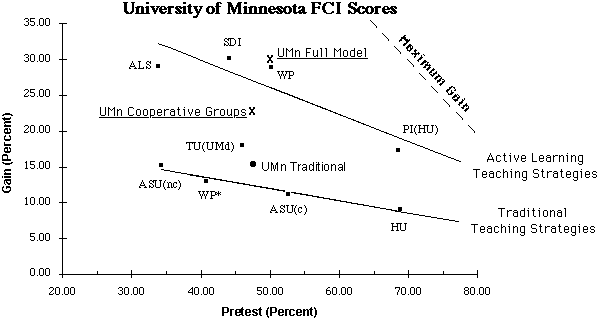
As one of many measurements we use to evaluate the effectiveness of our pedagogies, we give our students the FCI. The FCI is a 29 item multiple choice conceptual evaluation and can be found in The Physics Teacher, 1992 (Vol. 30, (3), pp. 141-151). Presented below are results from our introductory calculus-based physics for scientists and engineers (the 'x' on the graph).
Axes
- The horizontal axis is the average percent correct on the pretest.
- The vertical axis is the average absolute gain (posttest - pretest) after instruction.
Lines
- The dashed line in the upper right corner is the maximum possible gain.
- The bottom-most line is a linear fit of scores on the FCI from traditional instruction
- The top-most line is a linear fit of scores from more student-centered or active instructional approaches.
- These fits were done by Joe (E.F.) Redish.
Legend
- HU is Harvard University.
- PI (Peer Instruction) is the treatment group for HU.
- SDI is Socratic Dialog-Inducing Labs at Indiana University.
- ASU(c) and ASU(nc) were two traditionally taught courses at Arizona State University.
- ALS represents Active Learning Sheets developed at ASU by Alan Van Heuvelen, who is now at theOhio State University.
- WP is Workshop Physics by Priscilla Laws at Dickinson College.
- WP* are Workshop Physics labs poorly integrated into a traditional course.
- UMn Traditional is the University of Minnesota before we began our work on the calc-based introductory sequence.
- UMn Cooperative Groups is last year's data from the majority of our sections using our model for collaborative learning.
- UMn Full Model is our model for collaborative learning plus explicit instruction with a qualitative problem solving strategy.
Remember the FCI is a multiple choice test and is subject to the limitations of such a test, such as; some students will give right answers for wrong reasons. There is also some questions about what the test actually measures. For more information see The Physics Teacher, 1995 (Vol. 33, pp. 138-143) and The Physics Teacher, 1995 (Vol. 33, (11), pp. 502-506 and 503-511).
PER
Minnesota Model for Large Introductory Courses
- Home Page
- Minnesota Model Diagram
- Differences in Content and Structure From the Traditional Physics Course
- Reinforcement of Desired Student Behavious
- Our FCI Scores
